
However, it should be qualified: it will not be the longest total eclipse of the 21st century. The National Solar Observatory describes it as the second longest total solar eclipse of the 21st century, behind the 2009 eclipse.
Where will the maximum duration be?
The maximum duration of the eclipse will be reached in Egypt, near the Luxor area, in the Nile Valley. There, totality will last about 6 minutes and 22-23 seconds, an exceptional duration for a total solar eclipse. The path of totality will cross the Atlantic, the Strait of Gibraltar, North Africa, Egypt, the Red Sea, Saudi Arabia, Yemen, Somalia, and will end in the Indian Ocean.
Among the most attractive places to observe it will be southern Spain, Morocco, Algeria, Tunisia, Libya, Egypt, and Saudi Arabia. Egypt will be especially important because it combines a very long duration with historical locations such as Luxor and its temples.
And in Europe?
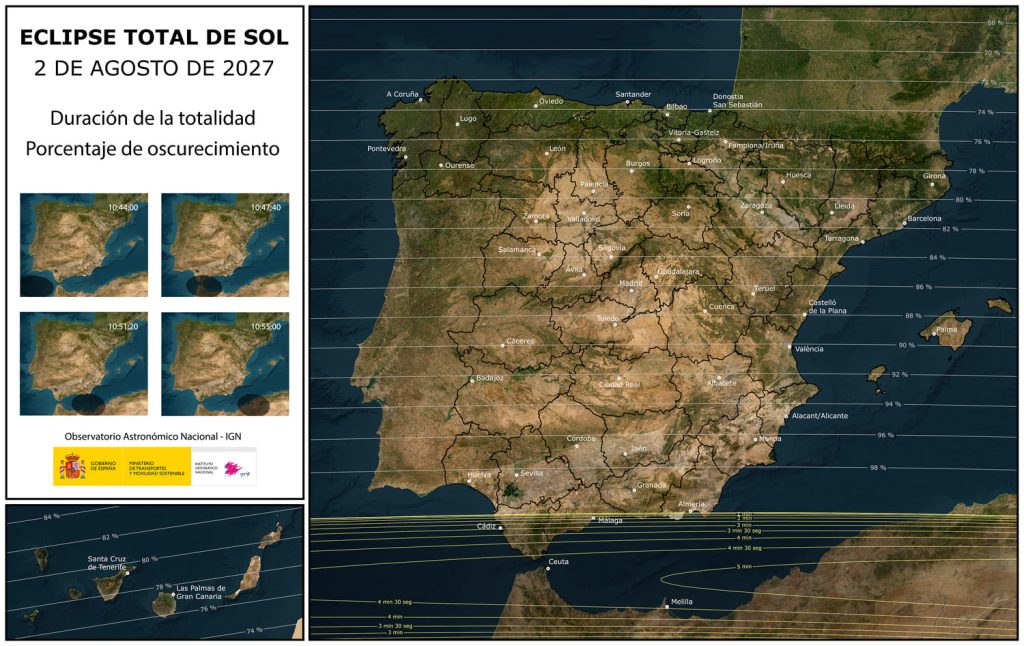
In Europe, totality will only be visible from Spain. The path of totality will pass through the far south of the country: Ceuta, Melilla, almost all of the province of Cádiz, a large part of Málaga, and the southernmost areas of Granada and Almería.
The longest duration in Spanish territory will occur in Ceuta, with about 4 minutes and 48-49 seconds of totality. On the mainland, some of the best areas will be around the Campo de Gibraltar and Tarifa. For example, Timeanddate estimates about 4 minutes and 40 seconds in Tarifa, 2 minutes and 56 seconds in Cádiz, and nearly 2 minutes in Málaga.
Outside the path of totality, the eclipse will be seen as partial across much of Europe, Africa, and western Asia. In Spain it will be partial throughout the entire territory, even outside of Andalusia.
Security Council
To observe the eclipse, you must always use certified eclipse glasses or appropriate solar filters during the partial phases. Only within the path of totality, and exclusively during the exact minutes when the Sun is completely covered, can you look without protection. As soon as even a tiny fraction of the Sun reappears, you must use protection again.
References
NASA Eclipse Web Site — Solar Eclipses 2021-2030
NASA / Fred Espenak — Total Solar Eclipse of 2027 Aug 02
National Geographic Institute — Total solar eclipse of August 2, 2027
National Solar Observatory — August 2, 2027 Solar Eclipse Map