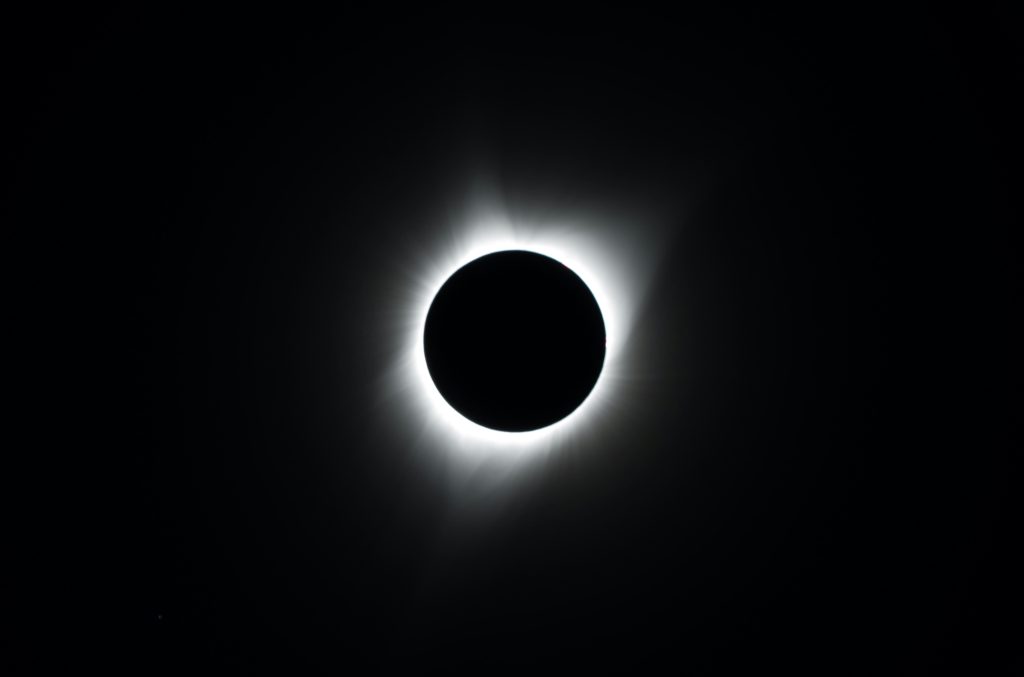
The total solar eclipse of August 2, 2027 will be much more than just a few minutes of darkness in the middle of the day. It is an extraordinary astronomical phenomenon that begins long before totality and is only fully understood when we can observe the relationship between the Sun, the Moon, the Earth, and the exact location from which we are watching.
That is why, EclipseSpain is developing a new 3D experience that will allow exploring the eclipse from different scales: from the territory where it will be observed to the alignment between the Sun, the Moon, and the Earth, and moving even further away, to a representation of the solar system with its planets and their orbits.
And there is an important difference compared to conventional animation:
- 3D will be able to work in real time.
- The visualization will use the date and time to represent the corresponding astronomical configuration for that moment.
- In this way, it will be possible to observe what is happening now, move through time to August 2, 2027, and visually follow the evolution of the eclipse.
A tool designed not only to amaze, but also to understand, learn, prepare for, and follow the eclipse.
What does it mean to see the eclipse in 3D and in real time?
“In real time” does not mean that we are showing a live feed from a camera located in space. It means that the 3D scene can depict the astronomical positions corresponding to the date and time we are viewing.
When the user selects Now, the display will use the current time as a reference. The clock will advance, and the display will update accordingly.
● REAL TIME · Aug. 20, 2026 · 6:34:27 a.m.
But there will be another particularly interesting possibility: time travel. Users will be able to scroll forward to August 2, 2027, and observe the progression of the eclipse. At that point, the indicator will change:
◷ SIMULATION · Aug. 2, 2027 · 6:42:15 p.m.
And it will always be possible to press: Back to Now. This clearly distinguishes what is happening at the present moment from an astronomical simulation corresponding to another point in time.
Three ways to explore the eclipse
1. Territory
The first view connects the eclipse to the real world. It will allow you to explore the region, the municipalities, the viewing areas, and other elements related to preparing for the event.
This is the practical layer: where to be and what will happen from there.
2. Eclipse
As we move away from the Earth's surface, we will be able to observe the relationship between:
Sun → Moon → Earth
This view will provide a visual understanding of how a solar eclipse occurs and why the alignment of these three celestial bodies can cause the Moon to completely obscure the Sun's disk from certain points on our planet. It will also serve as the main view for tracking the progress of the eclipse.
3. Solar System
And we'll be able to zoom out even further. The goal is to create a 3D representation of the solar system in which we can observe the Sun, the major planets, their positions, and the paths of their orbits.
Mercury, Venus, Earth, Mars, Jupiter, Saturn, Uranus, and Neptune will appear within the same interactive experience. The Earth will remain highlighted so that we never lose sight of the connection to the eclipse we are exploring.
From the solar system to the place where you'll gaze at the sky
One of the most interesting aspects of the experience will be precisely the ability to change scales. We’ll be able to start by observing the solar system, zoom in on Earth, understand its relationship with the Moon and the Sun, and continue zooming in until we reach the area from which the eclipse can be viewed. Or we can do exactly the opposite.
Start from our vantage point and gradually move away until we understand where we stand within a phenomenon involving bodies separated by enormous distances.
From the solar system to the observation point. That connection between the human scale and the astronomical scale is one of the central ideas of the project.
Follow the eclipse—don't just check the schedule
Normally, we search for an eclipse using specific data:
- What time does it start?
- When does totality begin?
- How long does it last?
- From where can it be seen?
All that information is necessary. But a three-dimensional experience can add something different: allow us to see how the phenomenon evolves.
The viewer will incorporate temporal controls with which it will be possible to scroll through the different phases of the eclipse, move forward or backward in time, and observe how the astronomical configuration changes.
The goal is to be able to reach the day of the eclipse and press something as simple as: Travel to the eclipse.
From there, the experience will be able to journey through the moments leading up to totality and advance to the climax:
- 60 minutes until totality
- There are 10 minutes left
- The entirety begins
- TOTAL ECLIPSE
- Complete the entirety
The intention is to connect that astronomical evolution with what will be happening on the Earth's surface.
Understand why a total eclipse occurs
The visualization will also be highly educational. We all know, in general terms, that a solar eclipse occurs when the Moon passes in front of the Sun as seen from Earth. But seeing it in three dimensions helps answer key questions:
- Why doesn't a solar eclipse happen every month?
- How can the Moon, which is much smaller than the Sun, manage to completely obscure it?
- Why can a total eclipse only be observed from a specific strip of land?
- Why does the duration change depending on the location?
- What is the relationship between the Moon's motion and the path we observe it taking as seen from Earth?
Changing the perspective, freezing time, or viewing the alignment from space makes it possible to visually explain concepts that might seem much more abstract on a two-dimensional diagram.
A tool for outreach and education
That is why 3D is not intended solely as a visual experience for those who will be observing the eclipse; it also has clear educational potential. It can help explain concepts related to:
- The movement of the planets and the Moon.
- The orbits and geometry of an eclipse.
- The relationship between the Sun, the Earth, and the Moon.
- The totality and its trajectory.
- Day and night.
- The different scales of the solar system and the temporal evolution of an astronomical event.
This can turn the tool into an interesting resource for families, schools, science communicators, astronomical associations, the media, talks, and activities organized by institutions or municipalities.
The idea is simple: turn an extraordinary phenomenon into an extraordinary learning opportunity.
Real astronomical positions, comprehensible representation
There is a problem when we try to depict the solar system completely accurately: the scales are enormous. If the planets and their distances were depicted strictly to scale on a conventional screen, many of them would be practically invisible.
Therefore, the experience will distinguish between two concepts:
- The astronomical positions and relationships they will be calculated based on the selected date and time.
- Certain sizes and distances they can adapt visually so that the user can understand what they are seeing.
It is not intended to be a physical scale model in which every planet has the exact same proportional size on screen. It is intended to be a Rigorous, understandable, and interactive astronomical visualization.
An experience that changes over time
Time will be one of the core elements of the viewer. The user will be able to stay in the present or move to another moment.
Among the planned controls will be:
Now · AUG 2, 2027 · Play · Pause · x1 · x10 · x100 · Back to real time
It will also be possible to activate different layers of information:
Show orbits · Show names · Follow Earth · Follow Moon · Follow eclipse · Day/Night
This will allow each user to use 3D in a different way. Some will simply want to explore; others, to understand the eclipse, observe the orbits, or use it as an educational tool.
An extraordinary eclipse deserves more than just a map
Maps will continue to be essential for deciding where to view the eclipse and planning the trip. But the eclipse on August 2, 2027, takes things a step further:
- We can connect practical information with astronomy.
- Planning with dissemination.
- The territory with the space.
- And the moment we lift our gaze to the sky with the astronomical movements that have made that moment possible.
That is the goal of the new EclipseSpain 3D: Explore. Understand. Follow. Live.
Follow the eclipse from the territory to the solar system
On August 2, 2027, millions of people will look up at the sky. Our intention is that before, during, and after that moment, they will be able to better understand what they are seeing.
- Explore the territory.
- Observe the Earth.
- Follow the Moon.
- Understand the alignment with the Sun.
- Travel through the solar system.
- And return to the place from which you will experience the eclipse.
From the solar system to the observation point.
Frequently asked questions
Does the 3D eclipse really work in real time?
The viewer is designed to calculate the corresponding astronomical representation for the selected date and time. In the mode Now, it will use the current moment as a reference. It will also be able to move temporarily to explore other moments, including the solar eclipse of August 2, 2027.
Is it a live broadcast from space?
No. “Real-time” refers to the calculation and representation of the current astronomical configuration, not to a camera broadcast.
Will it be possible to observe the Earth, the Moon, and the Sun?
Yes. One of the main views will be dedicated to the alignment between the Sun, the Moon, and the Earth, which is essential to understanding how a total solar eclipse occurs.
Will the other planets appear too?
Yes. The expanded view of the solar system is designed to include the eight main planets and their orbit lines.
Will I be able to see the eclipse of August 2, 2027, before it happens?
Yes. The time control will allow you to travel to that date and observe a simulation of the astronomical configuration and the evolution of the phenomenon.
Will the planets be completely to scale?
The astronomical positions will be calculated for the selected date and time, but certain sizes and distances may be represented with an adapted visual scale. A strict physical scale would make many elements practically impossible to view on screen.
Can it be used as an educational tool?
That is one of its objectives. The viewer will make it possible to visualize concepts such as orbits, planetary movements, the Sun-Moon-Earth relationship, totality, astronomical scales, and the temporal evolution of the eclipse in a much more intuitive way.