
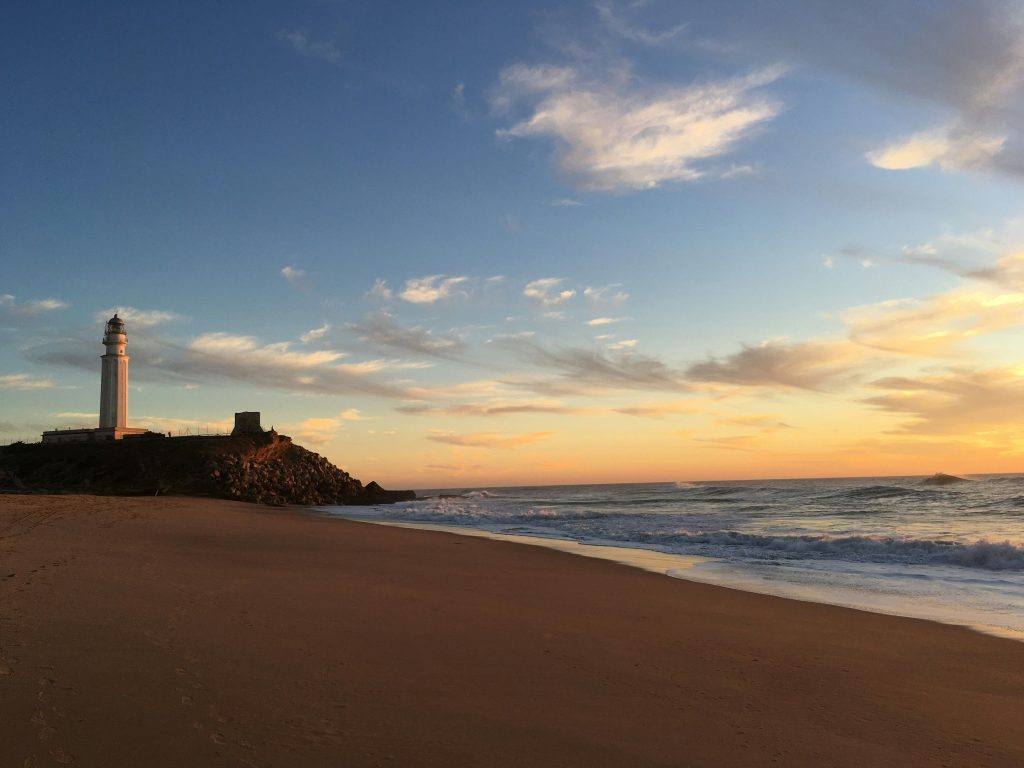
Our commitment to Barbate and its biodiversity
Thousands of people will look to the sky during the total solar eclipse on August 2, 2027. Our commitment is that when they leave, the ground remains the same. Eclipse Village 2027 is born from a simple idea: to organize the arrival and stay of visitors in a way that is compatible with respecting Barbate's environment, reducing improvisation, and placing environmental protection at the center of the operation.
An exceptional eclipse in an environment that deserves respect
Barbate is not only one of the privileged locations from which to observe the total eclipse of 2027. It is also part of an area of enormous natural value. The La Breña and Barbate Marshes Natural Park, located between Barbate and Vejer de la Frontera, is a maritime-terrestrial area of more than 5,000 hectares and constitutes a strategic point for migratory bird routes between Europe and Africa.
The Regional Government of Andalusia points out that this area is protected as a Natural Park, Special Protection Area for Birds (SPA), and Special Area of Conservation (SAC), within the Natura 2000 Network. It is home to marshes, pine forests, cliffs, dune systems, and habitats of Community interest. This context makes it necessary to approach any extraordinary concentration of visitors with special care.
That is why Eclipse Village's environmental commitment is not approached as a communications add-on, but as an integral part of the event's design itself: orderly access routes, designated areas, appropriately scaled services, waste management, fire prevention, noise and lighting control, prior information, and subsequent cleanup.
Our principle: prevent, minimize, measure, clean up and correct
We do not want to use expressions like “zero impact” if we cannot prove them. Bringing many people together in one place inevitably generates a footprint. The responsible goal is different: to prevent avoidable impacts, minimize the unavoidable ones, measure what happens, clean thoroughly, and correct any incidents that may occur.
This approach also explains why we advocate for planning and prior booking. Knowing how many vehicles and visitors will arrive makes it possible to appropriately scale access, restrooms, dining areas, staying zones, staff, security, and waste collection. The alternative—thousands of people looking for a spot at the last minute on trails, road shoulders, or sensitive areas—is precisely the scenario we want to avoid.
The measures that make up the environmental plan
1. Organized access and clearly demarcated areas
The venue will operate with prior reservation and access control. Parking, recreational, service, and circulation areas will be marked to prevent vehicles or people from occupying unintended spaces. Organizing arrivals is also an environmental measure: it reduces unnecessary travel, makeshift parking, and pressure on nearby roads and natural areas.
2. Waste: reduce, separate, and dispose
The environmental plan includes collection points distributed throughout the venue, separation of the main waste fractions, and continuous cleaning during the event. The priority will be to reduce single-use waste whenever feasible and work with suppliers to limit unnecessary packaging. Upon completion, a comprehensive cleanup of the space will be carried out.
3. Protection of soil, vegetation, and wildlife
Movement will be restricted to authorized areas, and zones that must not be stepped on or used will be marked. Information provided to attendees will emphasize not leaving litter, not disturbing the vegetation, not disturbing the wildlife, and respecting any specific environmental instructions established before the event.
4. Less noise and less unnecessary light
Eclipse Village is not conceived as a festival. The programming and services will be designed to avoid unnecessary noise levels and limit nighttime lighting to the bare minimum required for safety and operation. Reducing noise and light helps minimize disruptions to both the surrounding environment and local residents.
5. Sanitation and right-sized services
The presence of thousands of people requires sufficient sanitary facilities and proper management. The sizing of restrooms, cleaning, and removal of sanitary waste will be part of the operational planning to avoid impacts on the land and the surrounding environment.
6. Fire prevention
August is a high-risk month in southern Spain. Venue regulations must be strict regarding the use of fire, barbecues, pyrotechnics, or other behaviors incompatible with safety. Prevention and coordination with the relevant services will be an essential part of operations.
7. Mobility with less improvisation
Early booking and license plate control make it possible to know the expected volume of vehicles in advance and organize schedules and access. We will also study measures to promote carpooling and reduce unnecessary travel within the area. Ordered mobility does not eliminate traffic, but it can reduce part of its impact.
8. Information before arrival
Environmental commitment begins before August 1. Attendees will receive clear rules on waste, traffic, noise, fire, restricted areas, and responsible behavior. We want anyone who books to know from the start that enjoying the eclipse also means caring for the place from which they observe it.
9. Final cleaning and transparency
The operation does not end when everything is finished. Dismantling and subsequent cleaning are part of the event. The intention is to document the final result and publish, when the final plan is closed, basic indicators such as waste generated and removed, registered environmental incidents, and corrective actions taken.
A commitment that must be verifiable
Sustainability loses value when it becomes merely a label. That is why we prefer to talk about concrete and verifiable commitments. As the transaction closes, EclipseSpain will publish the final measures, the applicable protocols, and, whenever possible, the post-event results.
Among the indicators to be studied are the total volume of waste, the percentage separated by fractions, environmental incidents, cleaning and restoration activities, the number of shared vehicles, and compliance with access and traffic zones.
We also want to hear from Barbate
Territorial protection is not designed solely from an office. The project contemplates opening a dialogue with associations, local groups, and environmental entities to listen to concerns, identify risks, and improve planned measures. The goal is not to convince anyone with a slogan, but to demonstrate with facts that an extraordinary event can be organized responsibly.
Barbate has spent decades living alongside an exceptional natural heritage. Those of us who arrive to experience a few unrepeatable minutes have the obligation to respect it.
What we will ask of those who come to the Eclipse Village
The collaboration of every visitor will be essential. The final rules will be published before the event, but the principle will be very simple: use only authorized access points and areas; deposit each piece of waste in the designated bins; do not leave cigarette butts or trash; do not light fires; avoid unnecessary noise; do not enter restricted areas; and respect the flora, fauna, neighbors, and organizing staff.
The best photograph of the eclipse will be the one we can remember without leaving an unnecessary trace in the place from which we took it.
An eclipse that can also leave something positive
In addition to reducing the impact of the event itself, we are studying actions that can generate a positive return for the area: collaboration with local environmental initiatives, awareness-raising activities, cleanup or volunteering actions, and other measures that will only be finalized when they can be implemented in a realistic and verifiable way.
We will not announce commitments that we cannot yet fulfill. This article will be updated as the Eclipse Village 2027 environmental plan is defined in greater detail.
“Thousands of people will come to look at the sky. Our commitment is that, when they leave, the ground remains the same.”
Frequently asked questions
Can an event with thousands of attendees be considered sustainable?
A gathering of thousands of people always creates an impact. That is why Eclipse Village avoids promising a “zero impact.” The goal is to reduce the footprint through planning, advance booking, appropriately sized services, prevention, waste management, cleanup, and subsequent measurement.
How will Barbate's biodiversity be protected?
Limiting vehicles and people to authorized areas, preventing makeshift access, communicating clear environmental rules, and applying specific measures regarding waste, noise, lighting, fire, soil, and vegetation.
Will there be waste collection and separation?
Yes. The plan includes collection points, waste separation, and cleanup during and after the event. The final details will be published when suppliers and operational sizing are finalized.
Why does pre-booking also help the environment?
Because it allows knowing the demand in advance and sizing parking, access, restrooms, catering, staff, and waste collection. It also reduces improvised parking searches on roads, ditches, or unprepared areas.
Will environmental results be published after the event?
The intention of the project is to offer transparency regarding the outcome of the operation and to publish basic indicators when technically possible, including waste and environmental incidents and the cleaning or corrective actions taken.
Updated information
The operational environmental plan will continue to be finalized over the coming months. EclipseSpain will update this page once the protocols, providers, access rules, and metrics that will apply during Eclipse Village 2027 are confirmed.
Official sources
- National Geographic Institute (IGN): Total solar eclipse of August 2, 2027
- Regional Government of Andalusia – Environmental Portal: La Breña and Barbate Marshes Natural Park
- Andalusia Government – Natura 2000 Network: La Breña y Marismas del Barbate
- Regional Government of Andalusia – Governing Council Update on the protection and management of La Breña, Marismas del Barbate, and Tómbolo de Trafalgar (2025)