
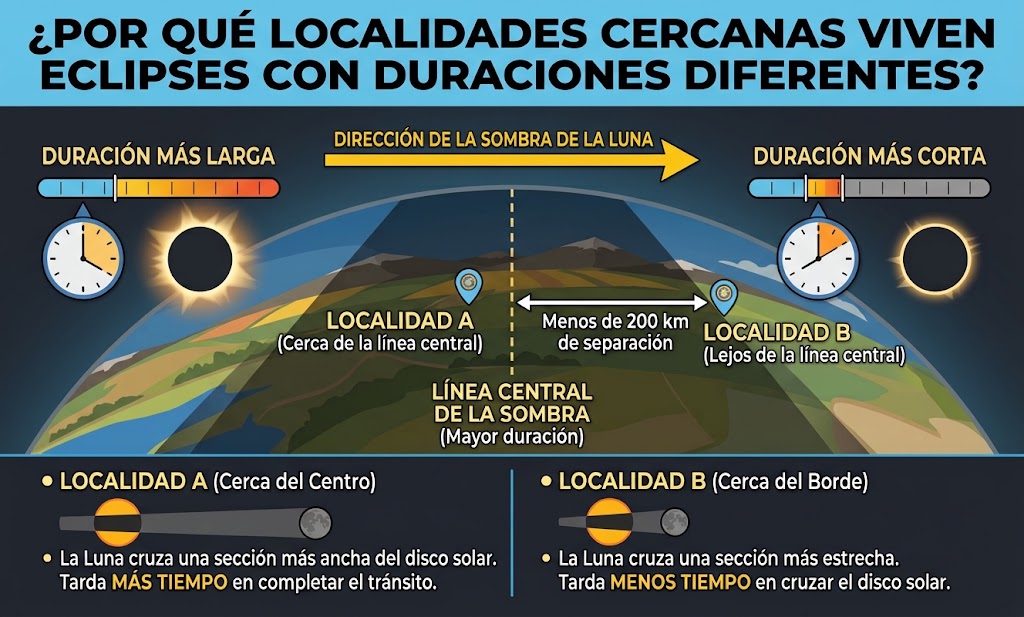
Two locations separated by less than 200 kilometers can experience total eclipses of very different durations. The reason is simple: the closer you are to the shadow's centerline, the longer it takes the Moon to completely cross the solar disk.
Reference table
| Locality | Province | Type | Approx. totality. |
|---|---|---|---|
| Tariff | Cádiz | Total | 4:33-4:40 |
| Zahara de los Atunes | Cádiz | Total | 4:26 |
| Barbate | Cádiz | Total | 4:18 |
| La Línea de la Concepción | Cádiz | Total | 4:24 |
| Conil de la Frontera | Cádiz | Total | 4:02 |
| Cádiz | Cádiz | Total | 2:56 |
| Jerez de la Frontera | Cádiz | Total | 1:37 |
| Estepona | Málaga | Total | 3:36 |
| Marbella | Málaga | Total | 3:21 |
| Fuengirola | Málaga | Total | 3:13 |
| Málaga | Málaga | Total | 1:57 |
In Granada and Almeria, it is especially important to consult the official visualizer because only the southernmost part of both provinces enters totality, and the duration drops off rapidly near the edge.
Why don't we include a single figure per province
A province does not “have” a duration. The eclipse depends on coordinates. In Cádiz, for example, Tarifa easily exceeds four minutes while Jerez is much closer to the northern edge. Giving a single provincial figure would be misleading.
How many seconds is it worth chasing?
For an expert observer, an additional thirty seconds can be invaluable. For a family, it might be better to sacrifice a few seconds in exchange for having restrooms, shade, parking, and avoiding a congested road. The table should serve for comparison, not to make the stopwatch the sole criterion.
What does it mean to be close to the edge
As you approach the limit of totality, the total duration shrinks until it disappears. Crossing just outside that line is enough for the eclipse to be partial. That is why we do not recommend choosing a “borderline” location without verifying the exact point. Malaga capital, for example, is inside, but offers much less totality than Estepona.
Rush hour
In Cádiz and the Strait, the local maximum will be around 10:46-10:47. In Málaga, it shifts to approximately 10:49. The differences are small: the important thing is to be set up well before second contact.
How to check your exact point
Use the IGN viewer or astronomical maps based on Besselian elements. Enter the municipality and, if possible, the exact location. For an organized observation, it is also advisable to confirm that the area has an unobstructed view and allowed access.
Safety: the rule that doesn't change
During the partial phases, you must not look directly at the Sun without specific protection. Eclipse glasses are not regular sunglasses: they must be appropriate solar viewers and comply with the transmission requirements of the ISO 12312-2 standard. In a total eclipse, only those within the path of totality can remove protection during the brief interval when the solar disc is completely covered; as soon as any bright part of the Sun reappears, eyes must be protected again. For cameras, binoculars, and telescopes, solar filters designed for optics and correctly placed in front of the objective are required.
Frequently asked questions
Where does it last longer in mainland Andalusia?
The Tarifa area is among the points with the longest duration on the peninsula, around four and a half minutes.
Barbate or Cádiz capital?
Barbate offers approximately 4:18 versus 2:56 in Cádiz capital.
Will Jerez have totality?
Yes, according to the published calculations, but somewhat shorter: around 1:37.
Can the figures vary?
Yes, a few seconds depending on the exact point within the municipality and the model used. To plan, check the exact coordinates.
Sources consulted
- https://www.timeanddate.com/eclipse/in/%406356950?iso=20270802
- https://www.timeanddate.com/eclipse/in/%402509369?iso=20270802
- https://www.timeanddate.com/eclipse/in/%402521335?iso=20270802
- https://www.timeanddate.com/eclipse/in/%402519289?iso=20270802
- https://www.timeanddate.com/eclipse/in/spain/cadiz?iso=20270802
- https://www.timeanddate.com/eclipse/in/spain/malaga?iso=20270802
- https://astronomia.ign.es/eclipses-de-sol-y-luna/eclipse-total-sol-de-2-de-agosto-2027